

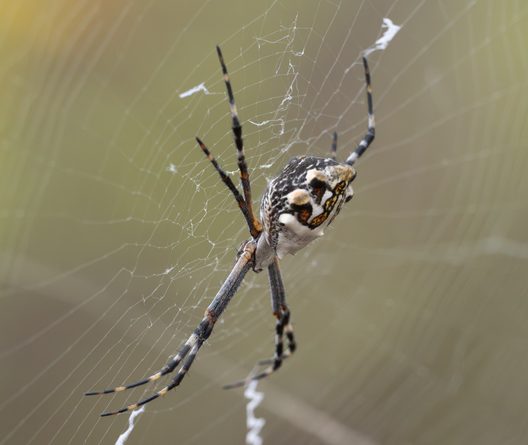
Just in time for spooky season, the orbweaver spiders at the estuary are thriving! This month’s iNaturalist spotlight goes to a photo of a gorgeous silver garden orbweaver (Argiope agentata) taken by alanking at the northeastern part of the Reserve.
The family of orbweaver spiders are known for their huge spiral-shaped webs. The web is UV reflective and often contains zig-zag “stabilimentum” decoration. These web features are thought to attract pollinators and possibly deter birds from crashing into them. The silver garden orbweaver typically waits for prey in the middle of its web in an “X” shape with its paired legs splayed out in 4 directions. Once it senses the vibration of its prey in the web, it races to it, paralyzes it with a bite, and quickly wraps it in silk. We know that this individual is a female due to her large size and distinct pattern. With legs extended females can be almost as big as your hand whereas males are about the size of your pinky fingernail. Some scientists speculate that the males are much smaller than the females to avoid detection; he may try to discreetly steal a bite of the female’s prey or try to mate with her. Silver garden spiders engage in sexual cannibalism meaning that the male is likely to be eaten during or after mating. Though brutal, this is common in spiders and it is a sacrifice the male is willing to take to pass on his genes.
If you happen to come across one of these beautifully fierce spiders in your garden, you do not have to worry about being bitten. A bump into their web by something as large as a human would simply send then scurrying away. Come explore the estuary and look for their sparkling webs amongst the coastal sage scrub habitat around the Visitor Center.