

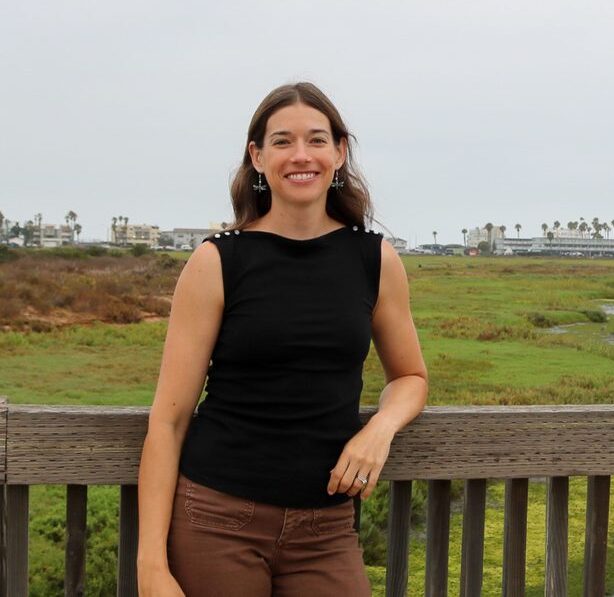
Dr. Michelle Shaffer is TRNERR’s Restoration Coordinator for the Tijuana Estuary Foundation.
Dr. Shaffer spent the past 13 years studying and practicing restoration ecology, food web modeling, and ecosystem resilience. In 2025, she explored the intersection of science and policy as a Sea Grant Knauss Marine Policy Fellow in Washington, DC. Dr. Shaffer earned her BS in Biology and PhD in Integrative and Conservation Biology from the University of Central Florida.
She is inspired by the incredible team at TRNERR and motivated by the creativity and collaboration required to restore and protect the Tijuana Estuary. Having grown up exploring estuaries across the United States, Dr. Shaffer developed a deep appreciation for their ecological, aesthetic, and social value that has shaped her career.
What brought you to the Tijuana Estuary?
Before coming to the Tijuana Estuary, I was a Knauss Marine Policy Fellow, which is a NOAA Sea Grant Fellowship. I ended up on the legislative track, placed in a California senator’s office. I made a lot of connections in that role, including with staff here at the Reserve. I’m from Florida, so I didn’t know a lot about the ecosystems on the West Coast and the issues they face. So, I visited California to connect with people in person and build relationships for the office.
I remember coming here to the Reserve, visiting Goat Canyon and Border Field State Park, and seeing the complexity of the issues alongside the beauty of the place. Even though it’s not in pristine condition, it’s really magnificent, and such an interesting intersection of the issues. Plus, the people are great.
How would you define your role?
I’m the Restoration Coordinator for TETRP (Tijuana Estuary Tidal Restoration Program). The way I think about it right now— just three weeks in — is that my role is the glue between all the pieces of TETRP. So, I’m making sure we have a well-developed monitoring plan and solid communications and outreach, and ensuring we hit the four points of the reserve system (education, stewardship, research, training and engagement) within our restoration. I’m sure my understanding of this role will develop as we reach implementation of the latest project, but I think I would be approaching this the wrong way if I went about it strictly scientifically.
What are you most excited about in your role or in moving to San Diego?
I am so excited to break ground on the restoration. Outside of work, I’m excited about snorkeling, getting back into diving, and then, when the weather gets better, getting out into the mountains and doing some climbing.
What do you want people to know about you or the restoration program?
About me: The thing I am really passionate about, and that put me on this track after graduate school, is the realization that much of the science ends up on a bookshelf and doesn’t always inform policy or positively impact communities. I think part of the public’s distrust of science is that we haven’t done a good job explaining what we do, and we don’t always design science with people in mind. I’m passionate about trying to bridge the gap between the two worlds.
About the Reserve: Our work here is so collaborative, and there’s so much more going on than you realize. We are working on that communication piece, so we can talk about what we do more effectively, so stay tuned!